

How to schedule twilight real estate shoots through the year
By Omnivou Team · Published · 6 min read
Schedule a twilight real estate shoot from the sunset time for that date and address, not from a fixed clock time. Book the photographer to arrive before sunset and keep them on site until civil twilight ends, about 30 to 45 minutes after sunset. In Vancouver in 2026 that window runs from after 9 pm in June to just after 5 pm in December, so a static "7 pm twilight" slot is wrong most of the year.
This guide is for studio owners and schedulers who sell twilight shoots. It covers what the window actually is, how much it moves, how to turn it into bookable slots, and the policies that keep twilights from wrecking the rest of the day.
What "twilight" means for a listing shoot
Astronomers split twilight into three stages by how far the sun sits below the horizon. Civil twilight runs from sunset until the sun's centre is 6 degrees below the horizon; nautical twilight goes to 12 degrees and astronomical twilight to 18, as the National Weather Service explains. For exterior listing photos, civil twilight is the useful part: the sky still holds colour, and interior and exterior lights start to show against it.
Photographers work that window in different ways. Some shoot a few frames before sunset and blend them with frames taken as the sky darkens; others shoot one sequence late in civil twilight. Either way, the photographer needs to be set up before sunset and finished by the end of civil twilight, and that end time is what your schedule has to respect.
How far the window moves in a year
The sunset time changes by hours across the year, and the length of civil twilight changes too. Here are figures for Vancouver from timeanddate.com's 2026 sun tables, on local clock time:
| Date | Sunset | Civil twilight ends | Window after sunset |
|---|---|---|---|
| March 1 | 5:55 pm | 6:27 pm | 32 min |
| March 21 | 7:27 pm | 7:59 pm | 32 min |
| June 21 | 9:21 pm | 10:05 pm | 44 min |
| December 12 | 5:13 pm | 5:51 pm | 38 min |
| December 21 | 5:16 pm | 5:53 pm | 37 min |
Two things stand out. First, the latest and earliest windows sit about four hours apart on the clock. A June twilight starts when a December twilight has been over for hours. Second, the window is not a fixed half hour. It is shortest around the equinoxes and longest around the June solstice, and it gets longer the further north you work.
The figures also change with location inside your service area. Over a few kilometres the difference is small, but across a wide region it adds up, and a hillside lot with a view to the west keeps usable light longer than a house in a valley.
Clock changes can move twilight overnight
Daylight saving time shifts every twilight by an hour on the day the clocks change. In Vancouver the March 1 sunset was 5:55 pm; after clocks moved forward on March 8, 2026, the sunset that evening was 7:07 pm. Any twilight slot set by hand has to be moved the same day.
Rules also change. British Columbia moved to permanent daylight time in 2026: the province's March 2, 2026 news release says clocks sprang forward on March 8 for the last time and did not fall back on November 1. As a result, B.C. winter sunsets now land an hour later on the clock than they used to. On December 21, 2026, the timeanddate tables show sunset at 5:16 pm in Vancouver and 4:20 pm in Seattle, about 190 km south, which still falls back each autumn.
For a studio that works on both sides of a border, or one whose software stores fixed slot times, this matters. Check that your scheduling tool uses current time-zone rules, and check the first twilight bookings after any rule change by hand.
Turning the window into bookable slots
A twilight slot is easiest to manage as a rule rather than a time. A workable rule set looks like this:
- Anchor the slot to sunset. Start the booking a fixed number of minutes before that date's sunset, for example 30 minutes, so the photographer can walk the property, set up and shoot the dusk frames.
- End it at civil twilight plus a margin. Block the photographer until civil twilight ends, plus time to pack up. In the table above that is roughly 70 to 90 minutes in total.
- Allow one twilight per photographer per evening unless two properties are very close. The window is too short to drive between them.
- Protect the slot before it. The afternoon job before a twilight has to finish with drive time to spare. Add a buffer so an overrun does not cost you the twilight.
- Set a cut-off for rush bookings. A twilight booked at noon for the same evening leaves no time to plan the route or check the weather.
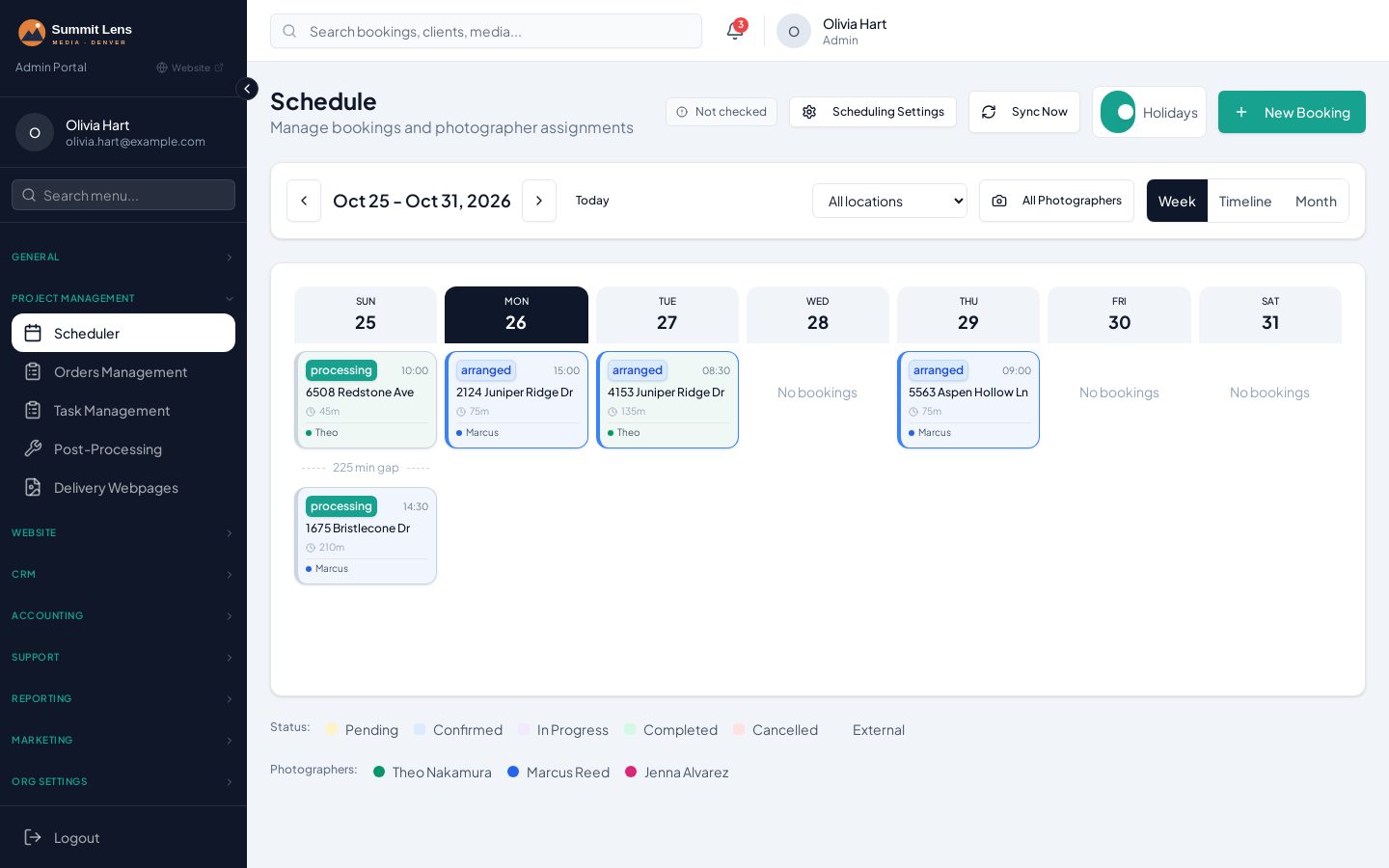
Doing this by hand means recalculating slots every week or two. Booking software can do it for you if it calculates sunset per date. In Omnivou's scheduling and dispatch module, for example, the last slot of each day follows that date's sunset, availability comes from each photographer's hours, jobs and Google Calendar, and each location has its own time zone. Agents then see only real twilight times on the booking form.
Weather and reschedule policies
A twilight depends on the sky more than any other shoot. Heavy cloud or rain can turn it into a plain night exterior. Decide in advance how you handle that, and put it in your booking terms:
- Decision time. Pick a fixed point, such as noon on the shoot day, when you confirm or reschedule based on the forecast. Agents can then tell their sellers when to expect lights on and blinds open.
- Weather reschedules. Decide whether moving a twilight for weather is free. The agent did nothing wrong, so charging for it is a hard sell. Whatever you choose, say it in the terms.
- Seller readiness. Ask that every interior and exterior light works and is switched on before the photographer arrives. A late seller costs more at twilight than at any other time.
- Virtual twilight as a fallback. Some agents will accept a day-to-dusk edit when the weather keeps failing. If you offer one, price it as its own product.
A forecast on the schedule helps with the decision. Omnivou shows a 16-day weather forecast on the scheduler, so the person dispatching can see a bad evening coming before the day arrives.
Pricing a twilight so the slot pays for itself
A twilight usually takes a photographer's whole evening for one property, while the same hours in daylight could cover more than one shoot. Price it to reflect that. Common approaches are a twilight package of its own, a twilight add-on to a daytime package at the same address, or a separate visit fee if the photographer has to come back. If you sell day-to-dusk edits as well, keep them separate from real twilight shoots so agents know what they are buying. Add-ons like these can also be offered after delivery from an upsell store on the delivery page.
A checklist for twilight bookings
- Slot start set from that date's sunset, not a fixed clock time
- Booking blocks the photographer through civil twilight plus pack-up
- No more than one twilight per photographer per evening unless jobs are next door
- Buffer after the afternoon job before a twilight
- Fixed weather decision time, written in your terms
- Seller checklist sent with the confirmation: all lights on, blinds open, cars moved
- Time-zone rules in your software checked after any change
If you are choosing software to run this, our guide to what real estate photography software should do covers booking, scheduling and the rest of the workflow, and the pricing page shows what Omnivou costs at your volume.